How To Install Aluminum Tile Trim
Updated: 26 Feb 2026
Installing aluminum tile trim is very simple. Simply prepare the necessary tools and materials, and follow our step-by-step instructions to complete the installation quickly.
Aluminum tile trim is a widely used building decoration material that not only protects tile edges and floors but also serves a decorative purpose. In fact, aluminum tile trim is a very easy-to-install decorative material. To help everyone quickly learn how to install it, Shenghai Aluminum has written this installation tutorial.
Tools and Materials Preparation:
To quickly install aluminum tile trim, we first need to prepare the following materials:
You will need to accurately measure the length of the tile edge (where the aluminum trim strip will be installed) using a tape measure. Mark the desired length on the aluminum tile trim with a pencil.
When cutting the aluminum tile trim, always wear protective gloves and safety goggles. Secure the aluminum trim strip to a flat surface to prevent it from slipping during cutting. Use a miter saw or a hacksaw to cut the aluminum trim strip perpendicularly along the marked line to the desired length. If the trim strip meets at a corner, be sure to cut at a 45° angle to ensure a seamless and aesthetically pleasing finish. After cutting, sand the cut with 240-grit sandpaper to remove burrs, sharp edges, and aluminum shavings. This prevents burrs from scratching your hands and also ensures a better fit between the trim strip and the tile.
Surface Preparation and Tile Adhesive Preparation
Clean the edges and corners of the tiles and the bonding surface of the aluminum tile trim, removing dust, oil, and debris to ensure the surface is dry and smooth.
Follow the instructions on the tile adhesive: mix it with water until it reaches a consistency that is "viscous but not dripping, and can be clumped together when lifted with a spatula." Let it stand for 5-10 minutes, then stir again to enhance adhesion.
Apply Tile Adhesive and Position the Tile Trim
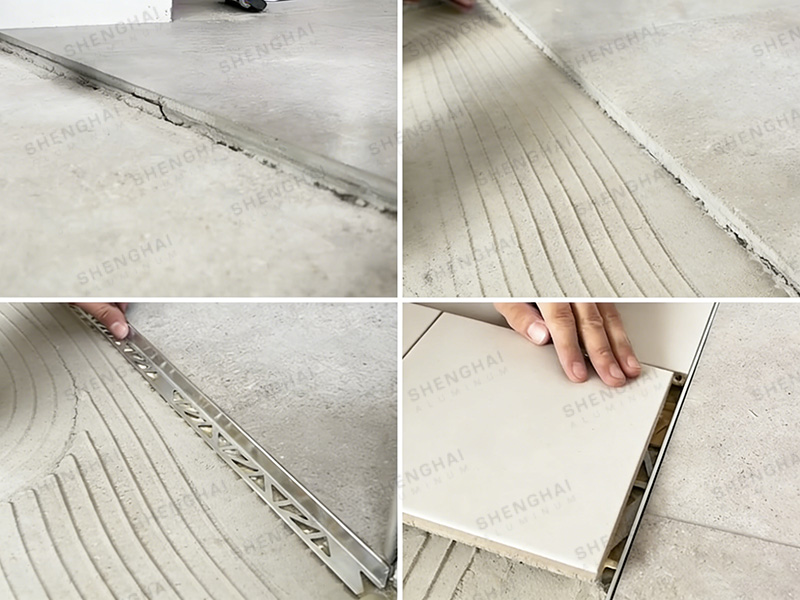
Use a trowel to evenly apply the prepared tile adhesive to the bonding surface of the aluminum tile trim. A sufficient thickness (3-5mm) is necessary to ensure a firm bond between the tile and the tile trim.
Align the tile trim with the applied adhesive and press it firmly onto the tile edge.
Use a level to check the verticality and flatness of the aluminum tile trim. If it is misaligned, adjust it by hand. Then use a rubber mallet to gently tap the tile trim along its surface to ensure a secure bond. Any excess tile adhesive that overflows should be wiped clean immediately with a damp sponge to prevent it from drying and becoming difficult to clean.
Gap Treatment
After the tile adhesive has fully cured, fill the gaps between the edge strip and the tile with grout, smooth them with a grout trowel, and wait until they are semi-dry (about 1-2 hours). Wipe off any loose powder with a damp sponge, remove any excess grout, and keep the surface clean.
After Installation
After installation,the aluminum tile trim should be securely fastened without looseness, with a smooth, even surface, tight joints without gaps, no cracks in the adhesive, and a clean surface free of adhesive residue. If the edge trim is found to be loose or the gaps are too large, add more adhesive, compact it, and allow it to cure again. Finally, please remember to avoid contact with water and stepping on the tile adhesive and grout before they cure. Tile adhesive takes approximately 24 hours to fully cure at room temperature, and grout takes approximately 48 hours. Cleaning can only be carried out after complete curing.
Cutting Safety: When cutting aluminum edge trim, always wear protective gloves and goggles to prevent flying metal shavings from causing cuts.
Curing Time: The curing time of the tile adhesive and grout must be strictly followed according to the product instructions. During the curing period, avoid collisions, stepping on, and contact with water to prevent the aluminum edge trim from falling off and the adhesive from cracking.
Color: The tile trim should preferably match or closely match the tile color. Alternatively, it can be matched to the color of decorative hardware (such as handles and baseboards) to enhance overall harmony.
Shenghai Aluminum is an aluminum edge trim supplier. If you need these decorative aluminum trim strips, please contact us immediately. We specialize in supplying building contractors and aluminum tile trim companies, so we have many ready-made aluminum edge trim systems to choose from, including: L-shaped trim, I-shaped trim, tile trim, floor edge trim, LED skirting, wall trim, etc. Or if you need an aluminum trim catalog, please contact us.
Aluminum tile trim is a widely used building decoration material that not only protects tile edges and floors but also serves a decorative purpose. In fact, aluminum tile trim is a very easy-to-install decorative material. To help everyone quickly learn how to install it, Shenghai Aluminum has written this installation tutorial.
Tools and Materials Preparation:
To quickly install aluminum tile trim, we first need to prepare the following materials:
- Aluminum tile trim (choose L-shaped, straight-edge, or T-shaped options as needed)
- Tile adhesive (e.g., tile glue, used to attach the aluminum decorative strips)
- Tile grout
- Measuring tape and pencil (for precise measurement and marking for cutting)
- Misaligned saw or hacksaw (for cutting the aluminum edging strips)
- Sandpaper (240 grit, for smoothing burrs on cuts)
- Grout gun (for filling gaps between the edging strip and the tile, ensuring a more aesthetically pleasing and waterproof tile installation)
- Grout trowel (for applying grout or tile adhesive)
- Level (to ensure the edging strip is installed flat)
- Rubber mallet (for tapping the edging strip to ensure it adheres to the tile)
- Bucket (for mixing and storing tile adhesive or grout)
- Damp sponge (for wiping away excess adhesive or grout from the edges of the tile trim, cleaning the work surface, etc.)
- Gloves and safety goggles (for protection against aluminum shavings and adhesive contamination)
- Utility knife (for trimming excess adhesive and cleaning gaps)
Aluminum Tile Trim Installation Steps
Measure and CutYou will need to accurately measure the length of the tile edge (where the aluminum trim strip will be installed) using a tape measure. Mark the desired length on the aluminum tile trim with a pencil.
When cutting the aluminum tile trim, always wear protective gloves and safety goggles. Secure the aluminum trim strip to a flat surface to prevent it from slipping during cutting. Use a miter saw or a hacksaw to cut the aluminum trim strip perpendicularly along the marked line to the desired length. If the trim strip meets at a corner, be sure to cut at a 45° angle to ensure a seamless and aesthetically pleasing finish. After cutting, sand the cut with 240-grit sandpaper to remove burrs, sharp edges, and aluminum shavings. This prevents burrs from scratching your hands and also ensures a better fit between the trim strip and the tile.
Surface Preparation and Tile Adhesive Preparation
Clean the edges and corners of the tiles and the bonding surface of the aluminum tile trim, removing dust, oil, and debris to ensure the surface is dry and smooth.
Follow the instructions on the tile adhesive: mix it with water until it reaches a consistency that is "viscous but not dripping, and can be clumped together when lifted with a spatula." Let it stand for 5-10 minutes, then stir again to enhance adhesion.
Apply Tile Adhesive and Position the Tile Trim
Use a trowel to evenly apply the prepared tile adhesive to the bonding surface of the aluminum tile trim. A sufficient thickness (3-5mm) is necessary to ensure a firm bond between the tile and the tile trim.
Align the tile trim with the applied adhesive and press it firmly onto the tile edge.
Use a level to check the verticality and flatness of the aluminum tile trim. If it is misaligned, adjust it by hand. Then use a rubber mallet to gently tap the tile trim along its surface to ensure a secure bond. Any excess tile adhesive that overflows should be wiped clean immediately with a damp sponge to prevent it from drying and becoming difficult to clean.
Gap Treatment
After the tile adhesive has fully cured, fill the gaps between the edge strip and the tile with grout, smooth them with a grout trowel, and wait until they are semi-dry (about 1-2 hours). Wipe off any loose powder with a damp sponge, remove any excess grout, and keep the surface clean.
After Installation
After installation,the aluminum tile trim should be securely fastened without looseness, with a smooth, even surface, tight joints without gaps, no cracks in the adhesive, and a clean surface free of adhesive residue. If the edge trim is found to be loose or the gaps are too large, add more adhesive, compact it, and allow it to cure again. Finally, please remember to avoid contact with water and stepping on the tile adhesive and grout before they cure. Tile adhesive takes approximately 24 hours to fully cure at room temperature, and grout takes approximately 48 hours. Cleaning can only be carried out after complete curing.
Precautions for Installing Aluminum Tile Trim
Type and Size: The selected aluminum tile trim must match the tile type and size. Different tile types and installation locations require different aluminum tile trims. For wall corners, L-shaped edge trim strips are preferred; for the junction of the floor and wall, T-shaped edge trim strips are preferred; and for straight-edge sealing of tiles and window sill/countertop edging, straight-edge trim strips are recommended. Tiles of different thicknesses require edge trim strips of different heights. For example, if the tile thickness is 8mm, an edge trim strip with a corresponding groove width must be selected.Cutting Safety: When cutting aluminum edge trim, always wear protective gloves and goggles to prevent flying metal shavings from causing cuts.
Curing Time: The curing time of the tile adhesive and grout must be strictly followed according to the product instructions. During the curing period, avoid collisions, stepping on, and contact with water to prevent the aluminum edge trim from falling off and the adhesive from cracking.
Color: The tile trim should preferably match or closely match the tile color. Alternatively, it can be matched to the color of decorative hardware (such as handles and baseboards) to enhance overall harmony.
Shenghai Aluminum is an aluminum edge trim supplier. If you need these decorative aluminum trim strips, please contact us immediately. We specialize in supplying building contractors and aluminum tile trim companies, so we have many ready-made aluminum edge trim systems to choose from, including: L-shaped trim, I-shaped trim, tile trim, floor edge trim, LED skirting, wall trim, etc. Or if you need an aluminum trim catalog, please contact us.